Foundation drainage – warning signs, methods and the ROT deduction
Damp in the basement or foundation may be caused by drainage that has stopped working. Here we go through the warning signs, how new drainage is installed, what affects the price, the ROT deduction and what to require from the company.
By the Fixtorget editorial team · Updated 8 November 2026 · 4 min read
What drainage involves
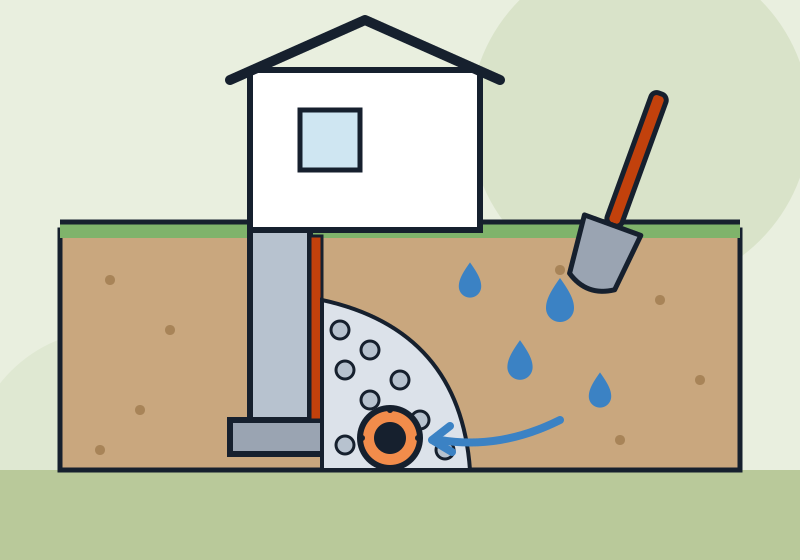
Drainage leads water away from the foundation so that moisture does not get into the basement or crawl space. A drainage system usually consists of a drain pipe around the foundation, free-draining material such as crushed stone, often a dimpled moisture membrane against the foundation wall and insulation, and a connection to the surface water system or a soakaway.
When drainage is replaced, the ground around the house is excavated down to foundation level, the old drainage is removed, the foundation wall is cleaned and damp-proofed and new drainage is laid. The trench is then backfilled and the ground reinstated.
Signs that the drainage needs attention
- Damp patches, salt deposits or flaking paint on basement walls.
- A mouldy or musty basement smell.
- Water on the basement floor after heavy rain.
- The house is older and the drainage has never been replaced.
- The ground slopes towards the house instead of away from it.
Damp can have several causes, such as condensation or leaking pipes. It is a good idea to let a moisture specialist or an experienced company examine the foundation before you decide.
What affects the price?
Drainage is often priced per linear metre, but every house is unique. Ask for a quote after a site visit.
- The perimeter of the house and the depth of the foundation.
- Ground conditions, such as clay, bedrock or stones.
- Obstacles around the house: decking, steps, paving and planting.
- Whether the foundation wall needs repairing, damp-proofing and insulating.
- Connection to surface water, a soakaway or a sump.
- Reinstatement of ground, paving and planting after the job.
Rules and safety
Underground cables and pipes must be located before digging. Owners of electricity, telecom, fibre and district heating networks can show where their cables and pipes run – requesting a cable location is often free of charge. Deep trenches require safety measures to prevent collapse. Where surface water may be discharged can be governed by municipal rules; contact the municipality if you are unsure where the water may be led.
ROT deduction
Drainage of an existing house foundation qualifies for the ROT deduction of 30 % of the labour cost. Materials, machine hire and removal of spoil do not normally qualify – ask the company to show the labour cost separately. ROT and RUT combined may not exceed SEK 75,000 per person per year, of which at most SEK 50,000 may be ROT. If you own the house jointly, you can both use your deduction.
What the quote should include
- Number of linear metres and whether the whole house or only parts are to be drained.
- Excavation depth and how the foundation wall is treated: cleaning, damp-proofing and insulation.
- Type of drain pipe, inspection chambers and free-draining material.
- How surface water and drainage water are led away.
- Reinstatement of ground and surfaces.
- Labour, materials and ROT deduction shown separately, plus warranty.
Questions to ask and common mistakes
- How do you make sure it is the drainage that is causing the damp?
- Do you install inspection chambers so the drainage can be maintained?
- How do you deal with cables and pipes in the ground?
- Do you have liability insurance if the foundation or pipes are damaged?
Common mistakes include replacing only the drain pipe without damp-proofing the foundation wall, leaving out inspection chambers, connecting downpipes to the drainage and not giving the ground a fall away from the house when reinstating.
Also think about timing. A drainage job often takes several days or weeks, and the ground around the house is dug up in the meantime. Plan how you will get in and out, where the car can be parked and how children and pets will be kept away from the trenches. Take the opportunity to review anything else in the ground next to the house, such as waste pipes or radon protection, since it becomes much more expensive to dig it all up again later.
Getting quotes through Fixtorget
Describe the house, the type of foundation and the damp problems you are seeing when you post your request for free. Up to four vetted companies can contact you. A larger job such as drainage is a good opportunity to compare quotes carefully and ask for the insurance documents in the chat.
Frequently asked questions
How do I know if the drainage is poor?
Damp, smells and water in the basement are common signs. Let a company or a moisture specialist examine the foundation to establish the cause.
Do I get the ROT deduction for drainage?
Yes, drainage of an existing house foundation qualifies for the ROT deduction of 30 % of the labour cost.
What is an inspection chamber?
A chamber that makes it possible to flush and inspect the drain pipe. It extends the life of the drainage.
Can I keep my paving and planting?
They often have to be lifted during excavation. Ask whether reinstatement is included in the quote.
This information is general and may change. Always check the current rules with the relevant authority, for example Skatteverket, Elsäkerhetsverket or Transportstyrelsen.
Get quotes from companies near you
Describe the job in a few minutes – free and with no obligation.
Post a job